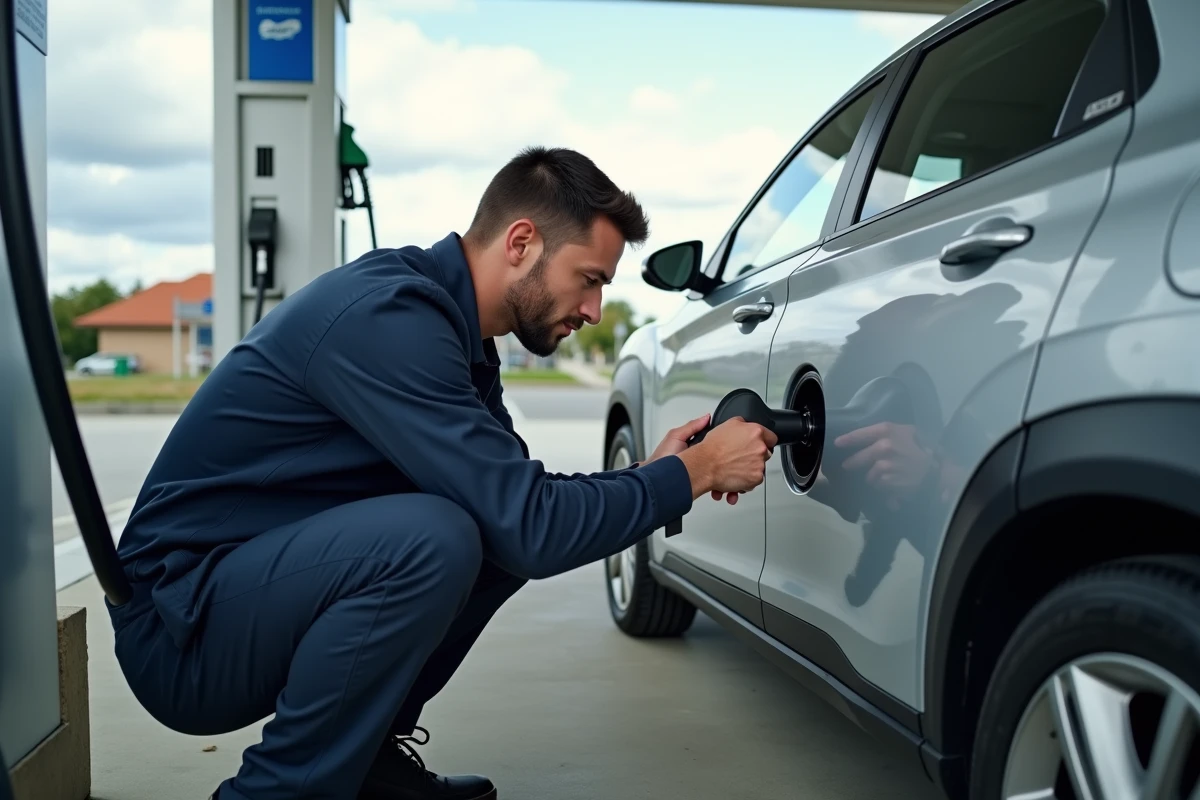
You fill up your Hyundai Kona and you’re hesitating between SP95, SP98, or E10. The nozzle is in hand, the price per liter is flashing on the screen, and the question comes up every time you stop at the station. The choice of fuel directly influences the engine’s behavior, its longevity, and your budget. For the Kona, the answer depends on the engine type, the vehicle’s year, and your daily usage.
Octane rating and turbo engine of the Kona: what’s happening under the hood
The octane rating measures the fuel’s resistance to auto-ignition. The higher it is, the better the fuel resists compression before igniting at the moment intended by the spark plug.
On the turbocharged engines of the Kona (1.0 T-GDI and 1.6 T-GDI), the air is compressed more than in a conventional atmospheric engine. This increased pressure raises the temperature in the combustion chamber. With fuel that has too low an octane rating, the mixture can ignite too early: this is known as knocking.
The engine control unit detects this knocking and reacts by delaying the ignition. The engine then loses responsiveness and power. On a flat city route, the difference is barely noticeable. However, during an uphill acceleration or an overtaking maneuver on the road, the delayed ignition results in a softer acceleration.
Choosing the right fuel for the Hyundai Kona therefore means finding the balance between engine protection and pump costs, taking into account the exact engine type of your vehicle.

SP95 E10 or SP98 for the Hyundai Kona petrol: which fuel to choose
Hyundai specifies in the owner’s manuals for recent Kona 1.0 T-GDI and 1.6 T-GDI models (2023 to 2025) that the engine is designed to run on SP95 E10. This is the reference fuel, the one on which engineers have calibrated the injection and ignition.
SP98 remains compatible and can provide a slight advantage in certain situations. According to Hyundai documentation, using a fuel with a higher octane rating can improve smoothness and responsiveness under heavy load, without notable benefits on consumption during steady driving.
When SP98 has a real advantage
If you often drive on the highway at high speeds, if you tow a trailer, or if you regularly drive in the mountains with passengers and cargo, the engine works harder. In these conditions, SP98 better limits knocking and reduces the ignition corrections imposed by the control unit.
For urban or suburban use at a moderate pace, SP95 E10 is sufficient. The extra cost of SP98 is not justified in this case, as the gain in responsiveness remains imperceptible under light load.
Beware of the quality of E10 fuel
Independent tests by ADAC on the Kona 1.0 T-GDI and 1.6 T-GDI show that poor-quality E10 fuel can cause problems on highway trips under heavy load. The source of the fuel matters as much as its octane rating. Favoring stations with recognized brands, with high sales volumes, ensures fresher and better-additized fuel.
Kona hybrid and Euro 6e standard: why fuel quality matters more
Since the gradual introduction of the Euro 6e standard for new registrations in Europe (starting from 2023-2024), Hyundai has adjusted the engine calibrations of the petrol and hybrid Kona. The goal: to reduce emissions in real driving conditions (RDE).
These calibrations make the engine more sensitive to fuel quality than with the earlier Kona Euro 6b or 6c. In hybrid versions, the thermal engine frequently stops and restarts. At each hot restart, combustion must be clean immediately. Good quality fuel facilitates this critical phase.

Have you ever noticed that your hybrid Kona seems more responsive some days than others? The fuel can sometimes be the cause. The control unit constantly adjusts the injection parameters, and poor-quality SP forces it to make more frequent corrections, which affects the smoothness of driving.
Practical summary: which fuel according to your Kona usage
Here are concrete guidelines to make the right choice at the pump:
- Urban use and short trips: SP95 E10 is perfectly suitable, it is the reference fuel recommended by Hyundai for the T-GDI engines of the Kona
- Highway, mountains, or heavy towing: SP98 provides a real benefit by limiting ignition corrections and preserving responsiveness under heavy load
- Kona hybrid Euro 6e: favor a high-flow station fuel, minimum SP95 E10, SP98 for long highway trips
- Kona electric: no fossil fuel, only charging at a station or home outlet
The owner’s manual remains the most reliable reference for your specific version. The model year, engine type, and pollution standard of your Kona determine the exact recommendations from the manufacturer. The best reflex is to check the fuel flap, where Hyundai usually indicates the minimum required octane rating. A fuel that complies with the recommendations protects the manufacturer’s warranty and keeps the engine in its optimal operating conditions.