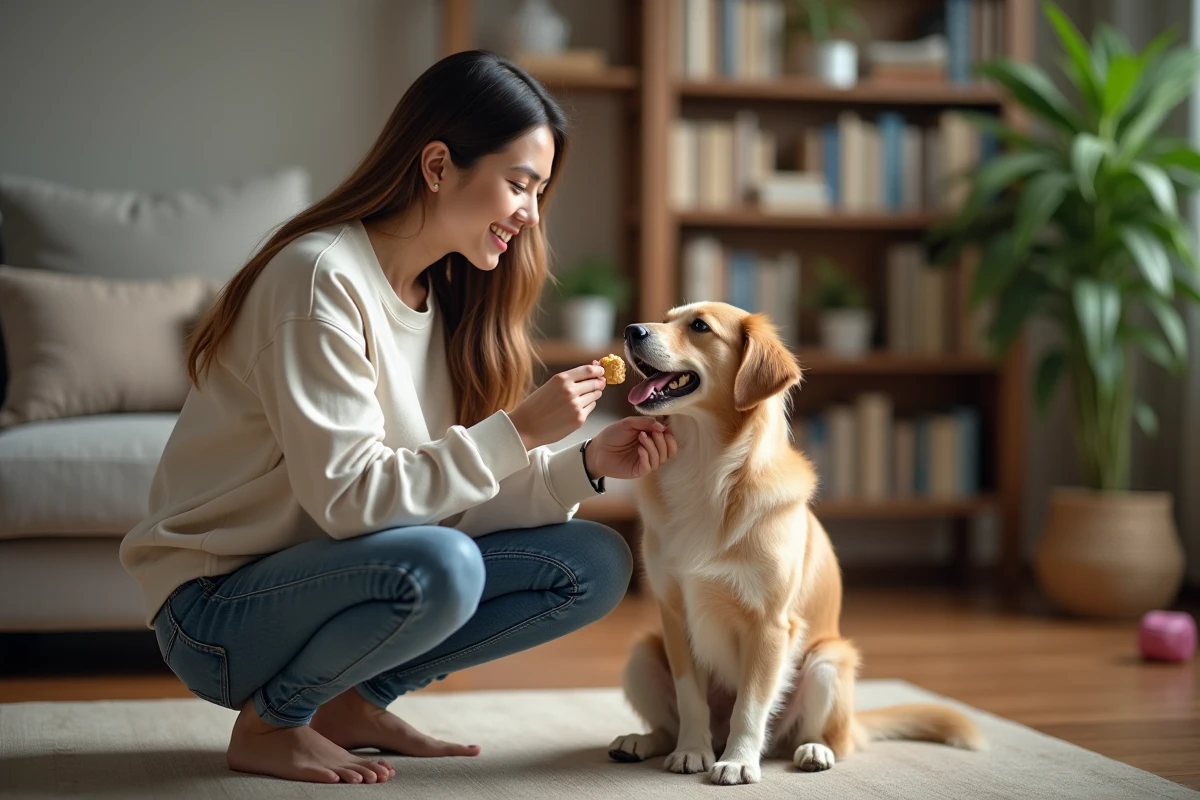
Ignoring undesirable behavior can prove more effective than punishment. Yet, the temptation to immediately correct a mistake persists among many owners. Research in animal ethology shows that a relationship based on trust and motivation yields more lasting results than education based on fear or coercion.
Recent studies point to an obvious fact: benevolent methods directly influence the mental and physical health of the dog. Consistency, patience, and recognition of good behaviors form the foundation of a harmonious life with your four-legged companion. Providing a structured framework, but never a rigid one, reveals the full power of respectful education.
Positive education: understanding the basics and overcoming misconceptions
Positive education has established itself as a learning method that respects the animal and its social nature. Positive reinforcement is at the heart of this approach: every progress, every good choice is rewarded. Here, punishment is set aside in favor of motivation and collaboration. Gone is the coercion: old methods that used fear too often generated stress and anxiety. Now, education becomes a dialogue.
What matters is the strength of the bond between human and dog. Rewarding a correct behavior with a treat, a pat, or an encouraging word embeds the right response over time. Forget coercive tools: this approach adapts to everyone, from the shy puppy to the old pro, regardless of breed or temperament. The key? Consistent rules, and the patience to give the animal time to understand. With each step taken, trust grows, and learning solidifies.
The benefits are quickly noticeable. A dog educated with respect listens better, calms down, and shows a greater ability to handle the unexpected. Far from automated training, positive education encourages adaptive intelligence, which limits the occurrence of behavioral issues.
To go further, attitudecanine.fr offers a comprehensive overview of the benefits of positive education and advice from committed professionals. Recommended by many veterinarians and dog trainers, this approach is part of a dynamic of respect and shared construction.
How does this approach transform your daily relationship with your dog?
Positive education transforms life together. It establishes a stable climate of trust, frees learning, and gives the dog the desire to explore, test, and progress at its own pace. Every shared moment becomes an opportunity to strengthen the bond, to build a balanced and lasting relationship.
The clear and reassuring framework allows the dog to grasp what is expected of it. Far from submissive obedience, it chooses to act out of the pleasure of succeeding and sharing. This dynamic also promotes socialization: a dog educated with respect integrates more easily, faces novelty without fear, and develops a true capacity for adaptation.
The benefits do not stop there. A noticeable decrease in behavioral issues is observed: separation anxiety, repeated barking, destruction. The dog, understood and supported, learns to be patient, to manage frustration, and to interact calmly, whether with its peers or with humans.
Here’s what this method concretely brings:
- Durable learning: progress is solid and lasts over time.
- Animal well-being: the dog evolves in a predictable environment, which gives it confidence.
- Trusting relationship: the bond is built on complicity, never on fear.
Many professionals, veterinarians, and trainers agree that consistency and listening to needs are the pillars of successful cohabitation with a dog.
Concrete advice to promote the well-being and development of your companion
To implement positive education, a few simple principles guide daily life. Positive reinforcement should take precedence: every progress deserves an appropriate reward, whether it’s a treat, a short game, or a word of praise. This regularity builds security and facilitates learning.
Basic commands like “sit,” “down,” “stay,” or recall should be practiced in different contexts, gradually complicating the situations. To teach house training or household rules, patience is essential, never punishment. Clicker training further refines understanding: a click signals the correct action, followed by a reward. This marking makes expectations clear for the dog and accelerates its progress.
Don’t overlook socialization and daily enrichment: increase outings, offer interactive games, organize meetings with other dogs, and vary environments. Personalized nutrition, chosen according to age, morphology, and activity, also supports overall balance. To avoid any confusion, all household members must apply the same rules with the dog.
Keep these essential points in mind:
- Appropriate reward: treat, pat, game, or praise depending on the situation.
- Repetition and consistency: learning is forged in regularity.
- Patience and respect for pace: every dog has its own tempo.
Over time, the relationship deepens, the dog flourishes, and daily life takes on a new hue. It’s up to everyone to invent, each day, a shared story where listening and trust pave the way for unexpected progress.