The profile of a Tesla customer is no longer limited to tech-savvy early adopters. Bain’s global survey of automotive consumers shows that price tops the list of purchase criteria in Europe, including in the premium segment, ahead of the brand itself. Technology and features matter, but brand loyalty to Tesla alone is no longer enough to explain a purchase.
Test-driving an electric vehicle and intent to buy a Tesla
Firsthand experience with an electric vehicle is the most underestimated factor in analyzing buyer profiles. Bain finds that people who have test-driven an electric vehicle say they are more likely to buy one. Mainstream European buyers have had this experience less often than premium buyers, creating a selection bias in Tesla’s customer base.
In practice, the Tesla buying journey rarely starts with a love-at-first-sight moment for the brand. It begins with a test drive—often in a friend’s or colleague’s car—that prompts buyers to reassess the cost-to-use ratio. The Supercharger network, seamless software and the ability to buy without visiting a traditional dealership complete the conversion.
To understand in detail who buys a Tesla, it is therefore important to distinguish between those drawn to the brand by environmental conviction and those who make the switch after direct contact with the electric vehicle ecosystem. This second group is growing and changing the customer base.
Tesla owner satisfaction: software versus charging speed
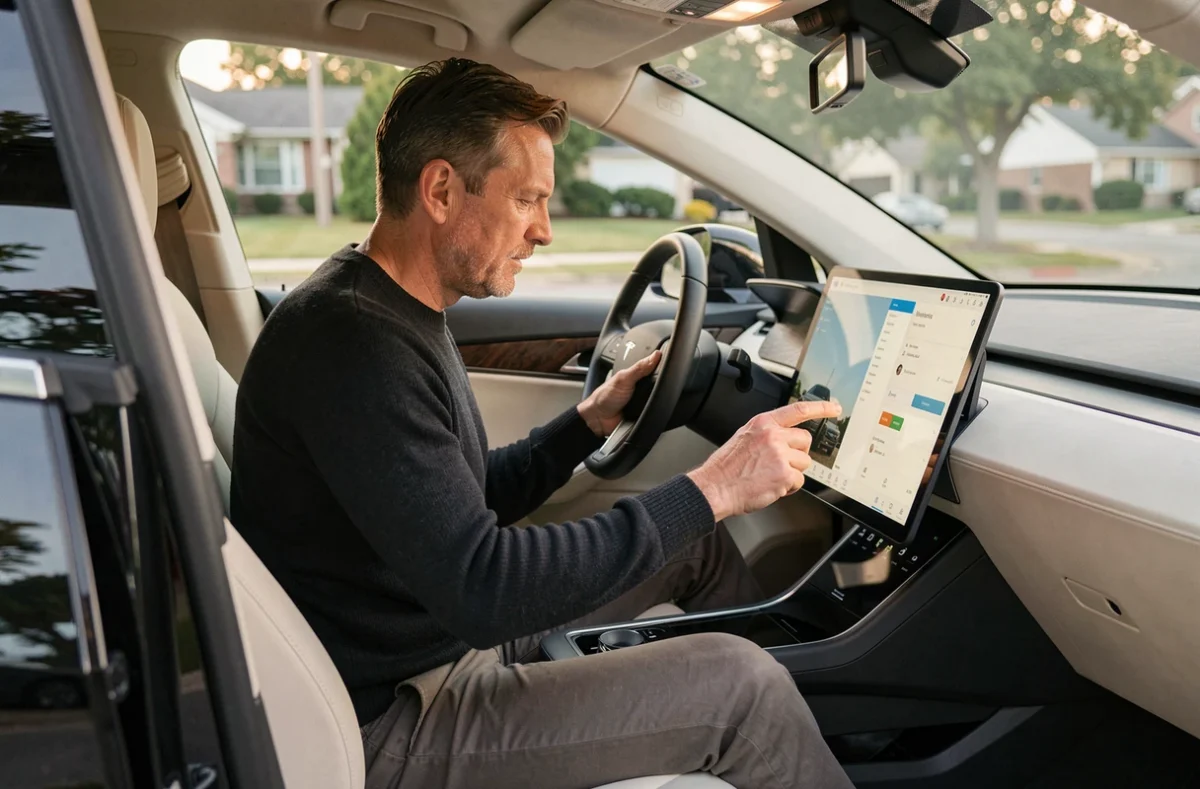
Feedback from Tesla drivers reveals a trade-off that spec sheets can obscure. Software and the mobile app are the most frequently cited sources of satisfaction, more so than outright range or acceleration. OTA updates, integrated route planning and battery preconditioning through the app create an experience that traditional automakers struggle to replicate.
Charging power, on the other hand, remains a recurring source of criticism. At third-party charging stations, the charging curve of the Model 3 and Model Y tapers off sooner than that of some European or Chinese competitors equipped with 800 V architectures. This trade-off between excellent software and hardware limitations on charging directly shapes the day-to-day driving experience.
What owners really value
- Seamless software integration (navigation, charging and climate control from a smartphone) that removes everyday friction
- The proprietary Supercharger network, seen as more reliable than third-party networks despite sometimes having a higher cost per kWh
- The relatively low depreciation of the Model 3 and Model Y on the used-car market, which reduces the total cost of ownership over three to five years
These factors carry more weight in building loyalty than brand prestige. An owner who is happy with the software is more likely to forgive average charging speeds than an owner disappointed with the interface is to forgive generous range.
Price and Chinese competition: the real trade-off for European buyers
According to Bain data, Gen Z and Gen Y are more open to buying battery electric vehicles than previous generations. But that openness does not guarantee they will choose Tesla. In Europe, stated concerns include the price compared with a similar combustion-engine model, charging time and the availability of charging infrastructure.
Competition from Chinese brands is reshaping the landscape. Tesla relies heavily on the Model 3 and Model Y for its European sales, while manufacturers such as BYD and MG offer models at significantly lower prices with comparable features. The recovery in Tesla registrations seen in several European markets does not hide this growing competitive pressure.
Concerns cited by hesitant European buyers
- The price premium over a combustion-engine vehicle of comparable size and trim, the leading concern in the Bain survey
- Charging time, perceived as incompatible with frequent long-distance travel, even though real-world use puts this concern into perspective
- The coverage of fast-charging stations, considered inadequate away from major highways in several European countries
Today’s Tesla buyer is not someone unaware of these concerns, but someone who has overcome them through experience. We find that the decision to buy depends less on ideological commitment than on practical calculations: cost per kilometer, acceptable charging time on regular journeys and the quality of the everyday interface.
The Musk effect and political image: a secondary but measurable factor
Elon Musk’s political statements have prompted waves of high-profile Tesla resales, particularly in Northern Europe. A link between the CEO’s image and purchase decisions exists, but it is not the primary factor. Drivers who sell their Tesla for political reasons are a visible but minority segment of the installed customer base.
The decisive factor remains the product experience. A driver satisfied with the Tesla ecosystem (software, charging network and maintenance costs) is more tolerant of controversy than a driver already frustrated by technical limitations. Brand image amplifies existing satisfaction or dissatisfaction; it does not act as an isolated trigger.
The 2026 Tesla customer is a pragmatic buyer. Firsthand experience with an electric vehicle matters more than brand appeal in the purchase decision. Software builds loyalty, charging divides opinion, and price acts as a filter.
As long as Tesla maintains its software lead and Supercharger network, we find that its customer base withstands reputational turbulence, even as Chinese competitors take a little more market share each quarter in the segment of first-time electric vehicle buyers.