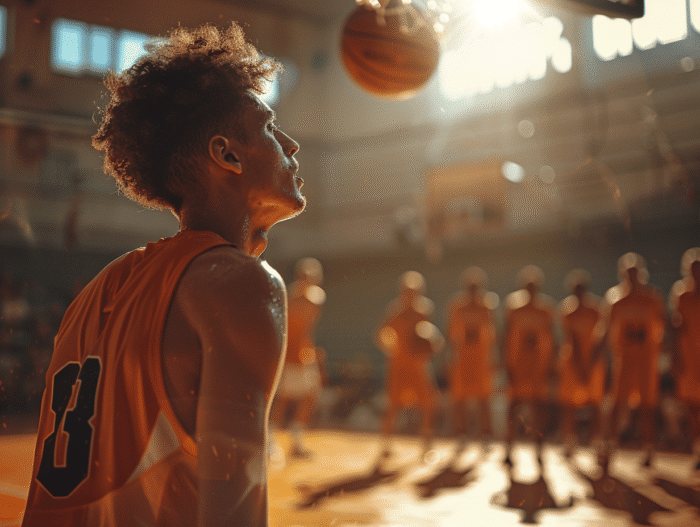
On the court, the whistles sound and players sometimes take a forced break for a precision exercise: the free throw. A key moment in basketball, this opportunity to score points without direct opposition is often surrounded by strict but not obvious rules for novices. Whether it’s the position of opposing and allied players around the key or the time allotted to shoot, every detail matters and can influence the success of the shot. This aspect of the game deserves attention to understand how these few seconds of concentration can change the course of a game.
The subtleties of the free throw: rules and tactical implications
The free throw is a penalty awarded to a player who has been fouled. In the heat of the action, the referee blows the whistle, the game stops, and the fouled player positions themselves behind the free throw line. Once in position, they have a limited time to execute their shot, usually five seconds. It should be noted that the distance of the free throw in basketball is 4.57 meters, a fixed measurement that leaves no room for improvisation. The slightest tremor, the smallest uncertainty can alter the trajectory of the ball, making the free throw both a technical and psychological exercise.
When a foul is called, not only does the concerned player receive one or more shots, depending on the nature of the foul and the context of the game—one point for each successful shot—but also, their teammates and opponents position themselves around the key. Some prepare for the rebound, while others increase the pressure. It is crucial to note that, during a three-point shot interrupted by a foul, the player may be awarded three free throws, thereby increasing the stakes of each action.
The flagrant foul, on the other hand, carries heavier consequences. Not only does the fouled player benefit from free throws, but possession also remains with their team, a rule that can prove decisive in the dynamics of the match. The free throw is not simply an isolated act, but a sequence that fits into a broader strategy, influencing the tempo of the game, the confidence of the players, and potentially, the final outcome of the confrontation.

The free throw in game strategy: between technique and psychology
The free throw transcends mere technique; it is a key moment where psychology comes into play. When a player steps up to the line, ball in hand, they bear the weight of their team’s expectations on their shoulders. Steve Nash and Stephen Curry, renowned for their accuracy, perfectly illustrate the technical mastery and calm needed to succeed in these critical shots. Their respective free throw percentages of 90.43% and 90.87% testify to their skill and mental preparation. In contrast, Shaquille O’Neal, famous for his struggles in this exercise, often saw his opponents employ the ‘Hack-a-player’ tactic, exploiting the psychological and technical vulnerabilities that may arise during the execution of a free throw.
Success at the free throw line can prove to be a decisive strategic advantage. Take Dirk Nowitzki and Elena Delle Donne, for example, both holders of accuracy records that have often turned the tide of their games. Dirk, with his unique shooting style, and Elena, with a historic perfect record in the WNBA, demonstrate the impact of impeccable technique coupled with unwavering concentration. Coaches, such as Gregg Popovich, do not hesitate to integrate these individual capabilities into their overall strategies, thus shaping game plans around these moments of truth.
The rules surrounding the free throw are not fixed and evolve over time. Governing bodies, under the leadership of figures like Adam Silver, commissioner of the NBA, are constantly consulted by legends such as Michael Jordan and Larry Bird to adjust and refine these rules to maintain fairness and fluidity in the game. The free throw remains a central element, a microcosm where accuracy, pressure, and strategy intertwine, inevitably influencing the course of each game.