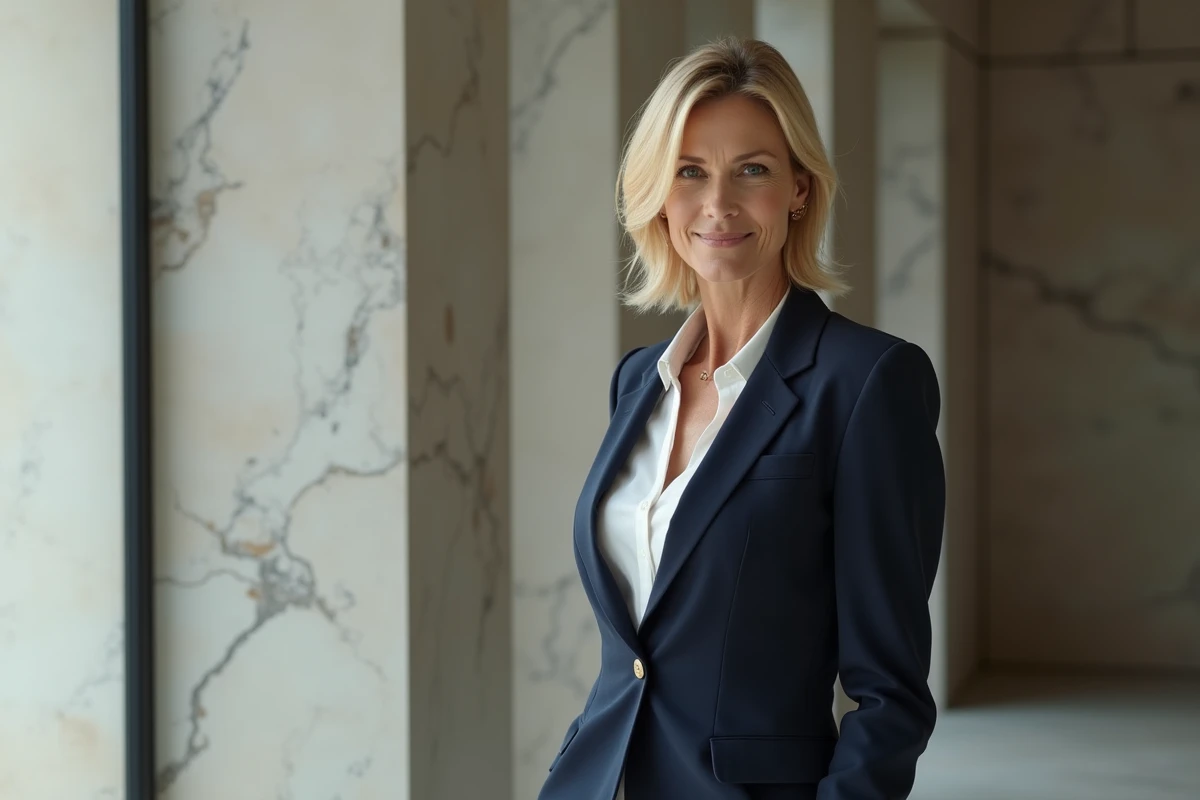
Scarlett Johansson is approximately 1.60 m tall. This seemingly mundane figure has fueled discussion threads, photo comparisons, and entire articles for years. The question of her height resurfaces with a regularity that says less about the actress than about how women’s appearances in Hollywood are treated as public data, open to ongoing debate.
Scarlett Johansson’s Height: Why a Simple Number Becomes a Subject of Fascination
An actress’s height does not appear in any film credits. It is also absent from reviews published after a premiere. It falls, in principle, into the same category as shoe size or natural hair color: a physical detail that has no bearing on talent.
With Scarlett Johansson, this detail has taken on another dimension. Specialized forums compare her stature to that of her male co-stars, shot by shot. Edits circulate to estimate whether she is wearing platform heels on the red carpets. What could be quickly addressed by consulting Scarlett Johansson’s height on 11 Le Magazine leads to debates elsewhere that stretch over hundreds of comments.
This obsession is partly due to a perceived discrepancy. In several of her film roles, Johansson occupies the screen with a physical presence that does not match the mental image of a woman of modest height. Black Widow engages in choreographed fights against much larger opponents. The screen erases her actual stature and creates a doubt that the audience then seeks to resolve.

Hypersexualization and Typecasting: When an Actress’s Body Defines Her Career in Film
The focus on Scarlett Johansson’s height does not operate in isolation. It fits into a broader pattern, documented by academic analyses on typecasting in Hollywood. The media combination of “short stature, voluptuous curves” has long influenced the roles offered to her.
For years, a significant portion of her filmography relied on characters where physical appearance served as a narrative engine. The camera’s gaze first framed a body before focusing on a character. This treatment is not unique, but Johansson’s case illustrates it with particular clarity because the actress has publicly managed to extricate herself from it.
Her transition to more complex roles marks a conscious break with these expectations:
- In Marriage Story, the film relies on the emotional accuracy of her performance, not on her appearance. Director Noah Baumbach films long scenes in fixed shots, where the body is no longer a spectacle but a vector of vulnerability.
- In Under the Skin, her physique is used as a narrative trap, turned against the conventions of the male gaze in cinema.
- With Her, she doesn’t even appear on screen: her voice alone carries the character, which eliminates any possibility of reducing her performance to a physical attribute.
These career choices constitute a direct response to typecasting. The media focus on her height and measurements has contributed to confining her to certain genres. The fact that she had to actively shed this to access other types of roles speaks to the workings of cinema, not to her stature.
The Physicality of Actresses Treated as Public Data: A Problem That Goes Beyond Scarlett Johansson
Debating an actress’s height on a forum may seem trivial. Accumulated, these micro-discussions produce a concrete effect. The female body becomes an object of collective verification, subjected to standards that no one has explicitly set but that everyone applies.
This phenomenon affects the entire film industry, but it concentrates with particular intensity on actresses whose public identity has been constructed around physical appearance. Scarlett Johansson herself mentioned, in an interview with InStyle, her decision to stay away from social media. She described herself as “too fragile” for these platforms, believing that their use would contradict her values.
This voluntary distance from social media takes on particular meaning when placed in this context. The absence of a personal account does not hinder the circulation of analyses about her body, but it allows her not to feed the machine directly.
The pop culture industry and French or international media continue to treat the physical characteristics of actresses as legitimate subjects for entire articles. Height, weight, and “physical transformations for a role” occupy a disproportionate editorial space relative to their actual relevance.
Scarlett Johansson and Physical Pressure in Hollywood: What the Debate About Her Height Reveals
The debate surrounding Scarlett Johansson’s height functions as a revealing mechanism. It shows that the perception of an actress remains filtered through physical criteria before being evaluated on artistic criteria. A filmography that spans over two decades, Oscar nominations, bold career choices—all of this takes a back seat as soon as an internet user raises the question of centimeters.
This mechanism is not specific to a particular era. It existed long before social media. Magazines from previous years already dedicated entire pages to the measurements of actresses. What has changed is the speed of dissemination and the volume. A snapshot taken on a red carpet generates dozens of comparative discussion threads within hours.
Johansson has navigated this system by alternating between mainstream roles (the Marvel franchise) and auteur projects where her type of performance takes precedence over everything else. This strategy has allowed her to build an artistic identity distinct from her media-exposed physical identity.
The fact that the question “what is Scarlett Johansson’s real height” continues to generate so many searches illustrates a persistent gap between what the public seeks and what matters in evaluating a career in film. The answer lies in three digits. The question, however, deserves to be turned around: why do we feel the need to ask it so much?