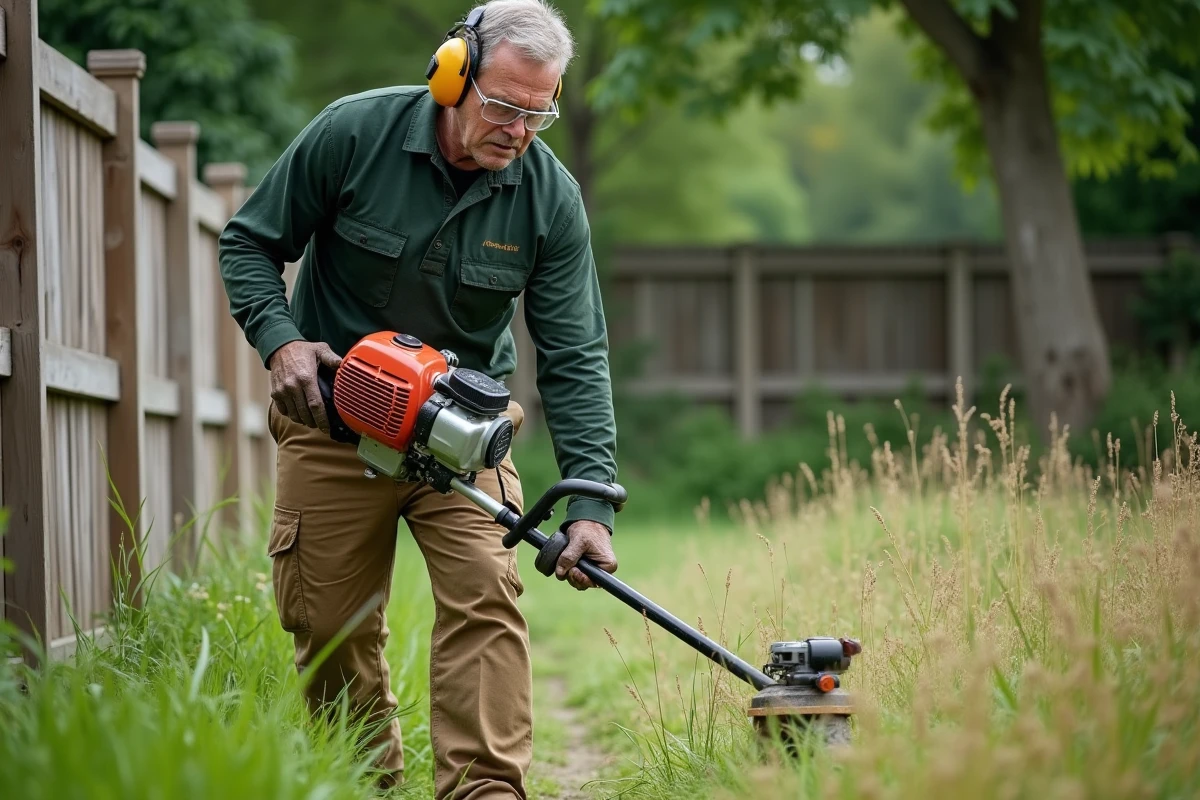
The market for thermal brush cutters remains dense, with ranges that cover both small residential gardens and semi-professional overgrown land. The criteria for choice are evolving: engine displacement and type of cutting head are no longer enough to differentiate models. Issues of noise, vibrations, and accessory compatibility weigh more heavily in the decision, especially for regular use in residential areas.
Vibrations and fatigue: the criterion that product sheets minimize
On a weeding job lasting more than an hour, muscle fatigue becomes the limiting factor, well before the engine power. Anti-vibration systems integrated into the chassis reduce the strain transmitted to the arms and shoulders.
Not all models are equal in this regard. Some manufacturers install silent blocks between the engine and the handle, while others settle for soft coverings on the handlebars. The difference is felt from the second half-hour of use, particularly on sloped terrain where the arm constantly compensates for the incline.
The harness plays a comparable role. A double harness with back distribution transfers the weight to the pelvis rather than the trapezius muscles. For a medium-sized garden with frequent maintenance sessions, the carrying comfort conditions the regularity of maintenance more than raw power. A detailed comparison of current models is available on top-debroussailleuse-thermique.com, allowing filtering based on these ergonomic criteria often absent from manufacturer sheets.
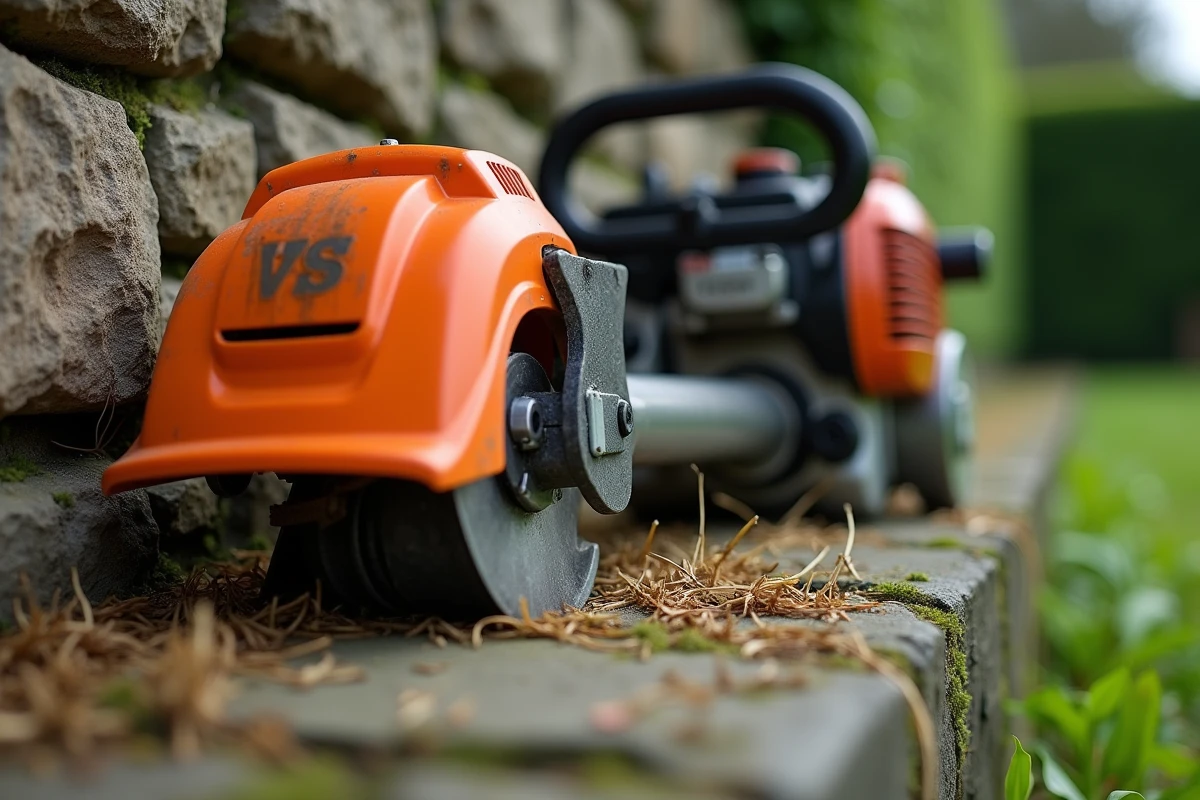
Engine displacement and thermal engine: adapting power to the actual terrain
Displacement remains the most consulted technical reference, but it only tells part of the story. A high-displacement engine on flat, regularly mowed terrain wastes fuel and adds weight to the machine without real benefit.
2-stroke or 4-stroke engine for a garden
The 2-stroke engine dominates the market for consumer thermal brush cutters. It is lighter, cheaper to produce, and delivers sufficient torque for most vegetation encountered in a garden. However, it consumes an oil-gasoline mixture and generates more emissions.
The heavier 4-stroke engine offers quieter operation and reduced consumption. The 4-stroke becomes relevant as soon as use exceeds several hours per week, especially on mixed terrains (tall grass, brambles, borders). For occasional finishing use, the additional cost and weight are less justified.
Noise level in residential areas
Recent guides emphasize noise level as a standalone criterion. In a housing estate, a noisy thermal brush cutter limits usage slots to the hours permitted by municipal decrees, reducing maintenance flexibility. Models equipped with acoustic reduction mufflers mitigate this problem without sacrificing power.
Cutting system: line, blade, or disc depending on the vegetation
The choice of cutting system directly depends on what you are cutting, not on the model of the machine. Most thermal brush cutters accept several interchangeable heads, but not all come with the complete kit.
- The nylon line head is suitable for soft grasses, border finishes, and areas around trees. It limits the risk of dangerous projectiles and preserves hard surfaces (walls, fences).
- The three or four-tooth blade tackles brambles, woody grasses, and shrub regrowth. It requires more sustained engine torque and an appropriate harness to absorb shocks.
- The steel or tungsten disc is aimed at dense underbrush and young trees. Its use remains occasional in a residential garden, but it transforms the brush cutter into a clearing tool.
A often overlooked criterion: the ease of changing heads. On some models, switching from line to blade takes less than a minute without tools. On others, it requires removing the protective cover and manually repositioning the fastening system. Real versatility depends as much on mechanical compatibility as on the practicality of assembly.
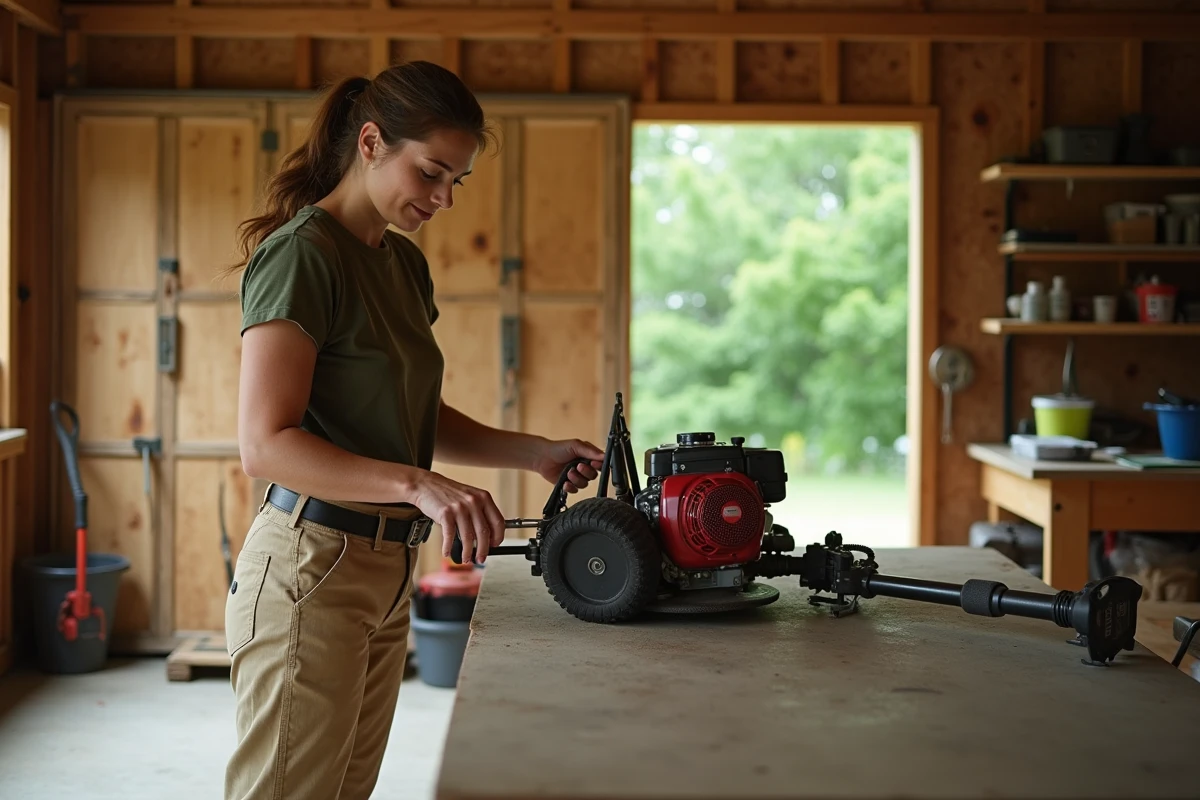
Thermal brush cutter for overgrown land: what changes
Field feedback varies on this point: a model performing well in regular maintenance may struggle on a plot left abandoned for several seasons. Woody vegetation, tangled brambles, and low stumps put different demands on the machine.
For this type of terrain, a rigid shaft transmission (rather than a flexible cable) offers better resistance to lateral forces. The conical coupling, the part that connects the shaft to the cutting head, absorbs repeated shocks. An undersized conical coupling breaks before the engine shows its limits.
The distinction between consumer models and professional models is not solely based on displacement. The quality of the transmission, the thickness of the casing, and the robustness of the harness attachment system separate the ranges. For a garden that includes even a modest area of overgrowth, aiming for a semi-professional model avoids premature breakdowns.
Maintenance of the thermal engine: actions that prolong lifespan
A poorly maintained thermal brush cutter loses performance by the second season. A clogged air filter reduces the mixture flow, causing starting issues and a loss of power under load.
- Clean the air filter after each prolonged use, and replace it at least once per season.
- Empty the fuel tank if the machine is stored for more than a few weeks. The 2-stroke mixture deteriorates and clogs the carburetor.
- Regularly check the spark plug: a black deposit indicates a mixture that is too rich or a saturated air filter.
- Grease the conical coupling according to the manufacturer’s recommendations, or risk accelerated wear of the gear.
Regular maintenance costs less than a trip to the workshop for a clogged carburetor or a seized conical coupling. These simple actions extend the machine’s lifespan by several seasons and maintain cutting power at its original level.
The choice of a thermal brush cutter hinges on the suitability for the terrain, frequency of use, and noise tolerance. A model too powerful for a small garden tires unnecessarily, while a model too light on overgrown land breaks quickly. Testing the weight with the harness in hand, checking the compatibility of cutting heads, and inspecting the anti-vibration system remain the three most reliable checks before purchase.